Andrew’s lingering trauma from the assault
The Cabin at the End of the WorldAndrew’s lingering trauma from the assault shapes his relationship with danger, firearms, and protection long after the attack itself. Guns offer a way to reclaim part of his earlier identity, but the weapon he brings to the cabin also becomes inseparable from the accident that kills Wen and from his subsequent grief.
The assault and its aftermath
Andrew grew up around guns in Vermont. His father took him hunting, and at ten gave him a .22 Huntington rifle. Andrew disliked hunting animals but enjoyed target shooting, spending much of his early teens firing at a gray stump behind the farmhouse. After moving to Boston, he rejected his Vermont past, including guns. That changed after an assault at a bar near Boston Garden, thirteen years before the cabin events.
Andrew took self-defense and boxing classes after the attack. They helped him feel more empowered; his nightmares became less frequent and his anxiety diminished, though the assault’s effects did not disappear. Within a year, he obtained a Massachusetts firearm identification card and joined a shooting range. He described the attack as having left him unmoored, as if the blow to the back of his head had broken off a part of himself that had not returned.
His explanation for returning to firearms was that shooting connected him with the boy he had been. Yet the range also gave the trauma a repeated form: once a month, he imagined the paper target’s silhouette as his attacker. Andrew knew that this practice felt good to him, even as he presented gun ownership to Eric as an effort to recover a lost piece of himself. The two motives coexist in his account: restoration of an earlier identity and an outlet shaped by the assault.
The gun as protection and concealment
Andrew kept his short-barreled .38-caliber revolver in a notebook-sized safe in the apartment closet. Bought eight months before the trip, the battery-powered safe could be opened with a touchpad combination or a biometric palm-print reader, with a safety key as backup. Eric had strongly opposed keeping a gun at home, and they had discussed the issue more than once, including before and after adopting Wen. They had agreed that Wen must not have access to either the gun or the safe.
Andrew decided to bring the safe to the cabin only minutes before leaving. He imagined possible dangers on the trip: bears and wild animals, but also hostility toward his family in a less socially liberal part of New Hampshire. He recognized that he was dwelling on worst-case scenarios, and tried to make himself feel foolish by humming Dueling Banjos. He brought the gun anyway, placing the safe in the SUV’s side compartment without telling Eric. Andrew knew the omission was unfair. He also expected Eric to worry more about Wen finding the safe and somehow opening it, a concern that made the concealed decision a source of strain as well as reassurance.
Violence at the cabin
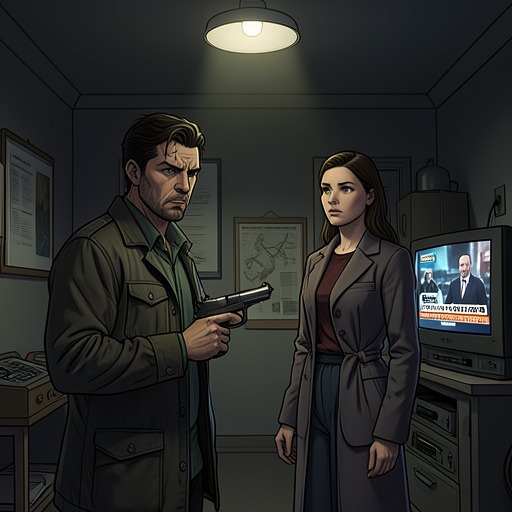
The cabin siege turns Andrew’s relationship with the gun from preparation for a feared threat into direct involvement in violence. He is forced to witness Leonard kill Redmond while Andrew is restrained. The scene establishes how completely the family’s captivity has removed ordinary control: Andrew has a gun with him, but it cannot protect him from what happens in front of him.
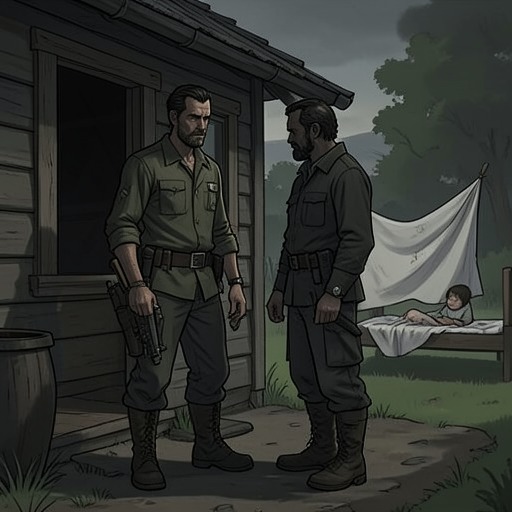
Later, during a struggle between Andrew and Leonard, both men have their hands on the gun. Leonard feels the trigger move under their joined hands; the gun fires, and Wen is hit. Andrew and Eric gather around her, holding and shielding her. The shooting is accidental, but its circumstances leave Andrew with no clean separation between the weapon he brought for protection, the physical struggle, and Wen’s death.
Memory, grief, and responsibility
Afterward, Andrew’s recollection returns to the sensation of Leonard squeezing his hands, his own finger folding against the trigger, and the gun’s recoil. These details persist as a tightly linked sequence rather than an abstract account of the accident. In the immediate aftermath, Andrew cannot bring himself to tell Wen that the shooting was accidental. Instead, he wraps her in flannel sheets, holds her, says her name repeatedly, and kisses her through the covering, as if carrying her home were the promise he could still make.
Leonard apologizes for having promised Wen that she would be safe. He tells Andrew the shooting was an accident, but cannot bring himself to voice the larger responsibility he feels for following the visitors’ demands and failing to resist them. His confession places the accident within the group’s coercion without removing Andrew’s direct, painful memory of the gun going off. Andrew’s trauma is thus compounded by bereavement and by the circumstances surrounding the death, not merely by fear of another attack. Even as he struggles with the memory, he decides he will not leave Eric or Wen alone again, a protective resolve shaped by the failure of protection at the cabin.